Table of Contents
- What Is a Tennis Bracelet Clasp?
- What Is an Underlock Clasp?
- Why the Safety Latch Matters
- Why Use an Underlock Tennis Bracelet Clasp?
- Underlock Clasp vs. Butterfly Clasp
- How to Open an Underlock Tennis Bracelet Clasp
- Why Won't My Tennis Bracelet Clasp Open?
- Why Does a New Tennis Bracelet Clasp Feel Stiff?
- How to Close an Underlock Tennis Bracelet Clasp
- Always Close the Safety Latch
- Common Tennis Bracelet Clasp Mistakes
- How the Clasp Looks on Bezel and Claw Set Bracelets
- Why Underlock Clasps Work Particularly Well on Bezel Bracelets
- How Tight Should a Tennis Bracelet Clasp Feel?
- What If the Safety Latch Becomes Loose?
- How to Care for an Underlock Clasp
- Underlock Clasps on Tennis Necklaces
- Underlock vs. Butterfly: Which Is Easier to Use?
- Choosing a Tennis Bracelet Is About More Than the Diamonds
- The Bottom Line on Tennis Bracelet Clasps
- FAQs
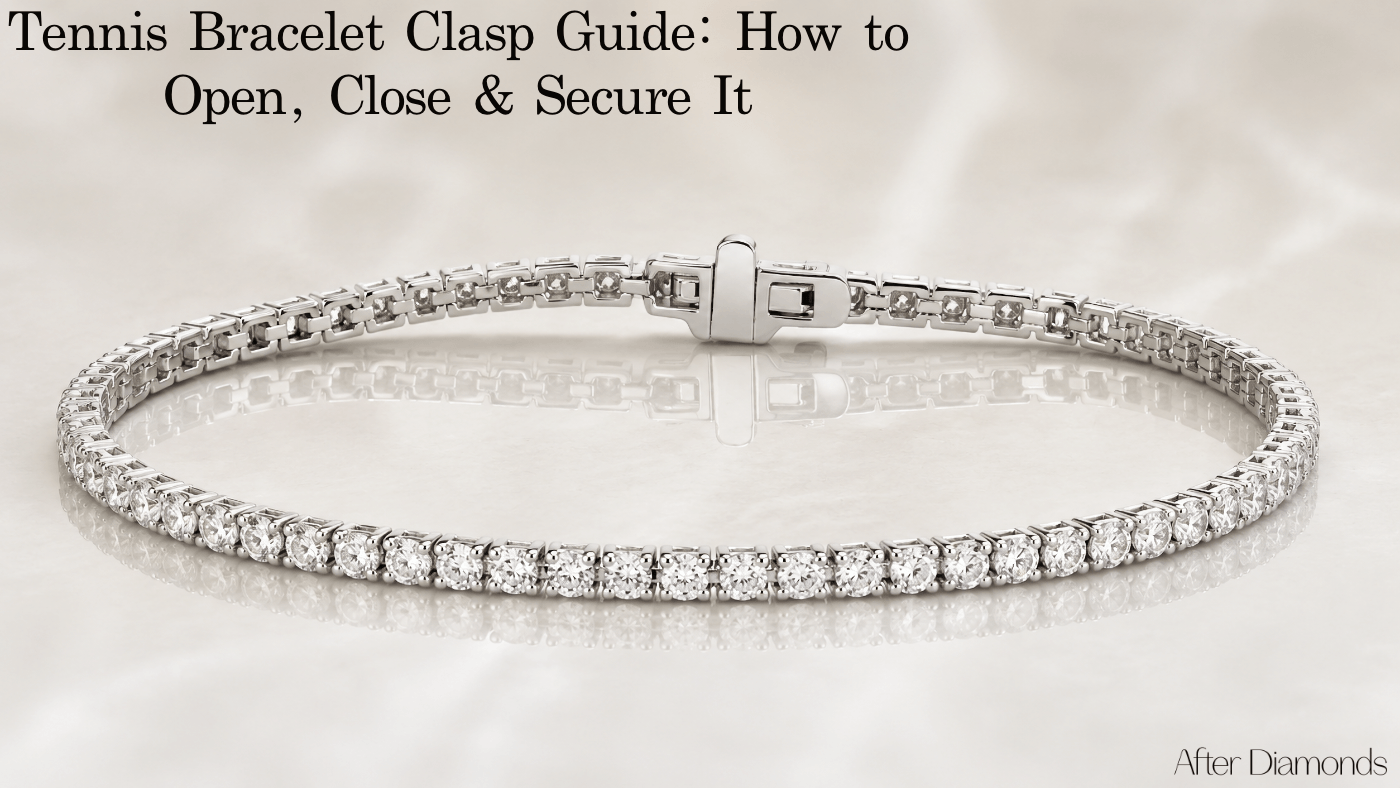
Tennis Bracelet Clasp Guide: How to Open, Close & Secure It
A tennis bracelet clasp has an important job. It needs to keep valuable jewelry securely fastened while remaining discreet enough that it does not interrupt the continuous line of diamonds.
At After Diamonds, many of our tennis bracelets use an underlock clasp with an additional safety latch underneath. This design provides two levels of security while allowing the clasp to blend naturally into the bracelet.
An underlock tennis bracelet clasp can feel unfamiliar the first time you use one. Unlike a butterfly clasp, it does not unfold into several hinged sections. Instead, one end slides into the receiving portion of the clasp and locks into place. A separate safety latch underneath provides additional protection against accidental opening.
The opening sequence matters.
You first release the lower safety latch. Then you press the main release while gently sliding the clasp apart.
Simply pulling on the bracelet will not open it.
This guide explains how an underlock tennis bracelet clasp works, how to open and close it correctly, how the safety latch functions, how underlock and butterfly clasps differ, and the most common mistakes to avoid.
What Is a Tennis Bracelet Clasp?
A tennis bracelet clasp is the mechanism that joins the two ends of the bracelet and keeps it secured around the wrist.
Because tennis bracelets are flexible and may contain dozens of individually set diamonds, the clasp needs to provide more security than a lightweight decorative closure.
A good tennis bracelet clasp should combine:
Security
Durability
Comfort
Ease of use
A discreet appearance
The clasp should hold firmly during ordinary wear without becoming a large visual interruption in the line of diamonds.
That is one of the reasons an underlock clasp works particularly well on tennis jewelry.
What Is an Underlock Clasp?
An underlock clasp is a compact closure where one end of the bracelet slides into the receiving section and locks securely in place.
On the designs used across many After Diamonds tennis bracelets, the clasp also includes a separate safety latch underneath.
The two mechanisms serve different purposes.
The main underlock is the primary closure. It physically connects the two ends of the bracelet.
The lower safety latch acts as a secondary safeguard. Once secured, it helps prevent the main clasp from accidentally opening during wear.
When everything is closed properly, much of the hardware sits underneath or within the diamond-set portion of the bracelet.
This allows the clasp to remain relatively discreet.
Why the Safety Latch Matters
The small latch underneath the tennis bracelet clasp is not decorative.
It is an additional safety mechanism.
A tennis bracelet moves constantly while being worn. Your wrist bends, sleeves pass over the jewelry, and the bracelet may occasionally come into contact with furniture, bags, clothing, or other objects.
The lower safety latch provides another layer of protection if pressure is placed on the main clasp.
This means the bracelet is secured in two stages:
The main underlock engages.
The safety latch underneath closes over the mechanism.
Both should be properly secured before the bracelet is worn.
Why Use an Underlock Tennis Bracelet Clasp?
One of the defining features of a tennis bracelet is the uninterrupted appearance of the diamonds.
A large, bulky clasp would break that visual flow.
An underlock tennis bracelet clasp allows much of the mechanism to remain hidden beneath or within the design.
This can work particularly well with:
Bezel set tennis bracelets
Claw set tennis bracelets
Higher carat weight bracelets
Tennis necklaces
Other continuous line diamond jewelry
The clasp remains functional and secure without becoming the focal point.
Underlock Clasp vs. Butterfly Clasp
Underlock and butterfly clasps can both be used on fine jewelry, but they operate very differently.
Underlock Clasp
An underlock clasp uses a sliding locking mechanism.
One end of the bracelet enters the receiving side and locks into position.
On the style used on many After Diamonds tennis bracelets, there is also a safety latch underneath.
Typical characteristics include:
Low profile
Sliding closure
Compact construction
Separate lower safety latch
Main release that must be intentionally pressed
Minimal interruption to the diamond line
Butterfly Clasp
A butterfly clasp uses hinged sections.
When opened, the clasp unfolds outward into two sides or wings.
When closed, those sections fold inward underneath the bracelet or watch.
Typical characteristics include:
Hinged folding sections
Wider opening when released
Symmetrical folding action
More hardware beneath the jewelry
Different opening motion from an underlock clasp
Which Is Better for a Tennis Bracelet?
Both designs can work well when properly made.
The underlock design has a particular advantage on traditional tennis jewelry because it can blend more naturally into the continuous line of diamonds.
The separate lower safety latch also gives the wearer an additional security mechanism without requiring a large folding clasp.
A butterfly clasp may be easier for some wearers to recognize immediately, but it generally introduces more visible mechanical structure beneath the bracelet.
How to Open an Underlock Tennis Bracelet Clasp
The most important thing to remember is that there are two mechanisms to release.
The lower safety latch must be opened first.
Then the main underlock release can be pressed.
Do not simply pull the two sides of the bracelet apart.
Step 1: Release the Safety Latch Underneath
Turn the clasp slightly so you can access the underside.
Locate the small safety latch beneath the main clasp.
Gently move it away from the clasp until it disengages.
It should only be moved far enough to clear the locking mechanism.
Do not bend it excessively.
If the safety latch remains closed, the bracelet may resist opening even if you are pressing the main release.
Step 2: Hold the Bracelet Close to the Clasp
Hold both sides near the clasp rather than farther down the diamond links.
This gives you better control and prevents unnecessary tension from being placed on the bracelet.
Keep the two sides relatively straight.
Avoid twisting them in opposite directions.
Step 3: Press Down on the Main Release
Locate the release point on top of the underlock clasp.
Press firmly downward.
Keep pressure on the release while preparing to separate the two sides.
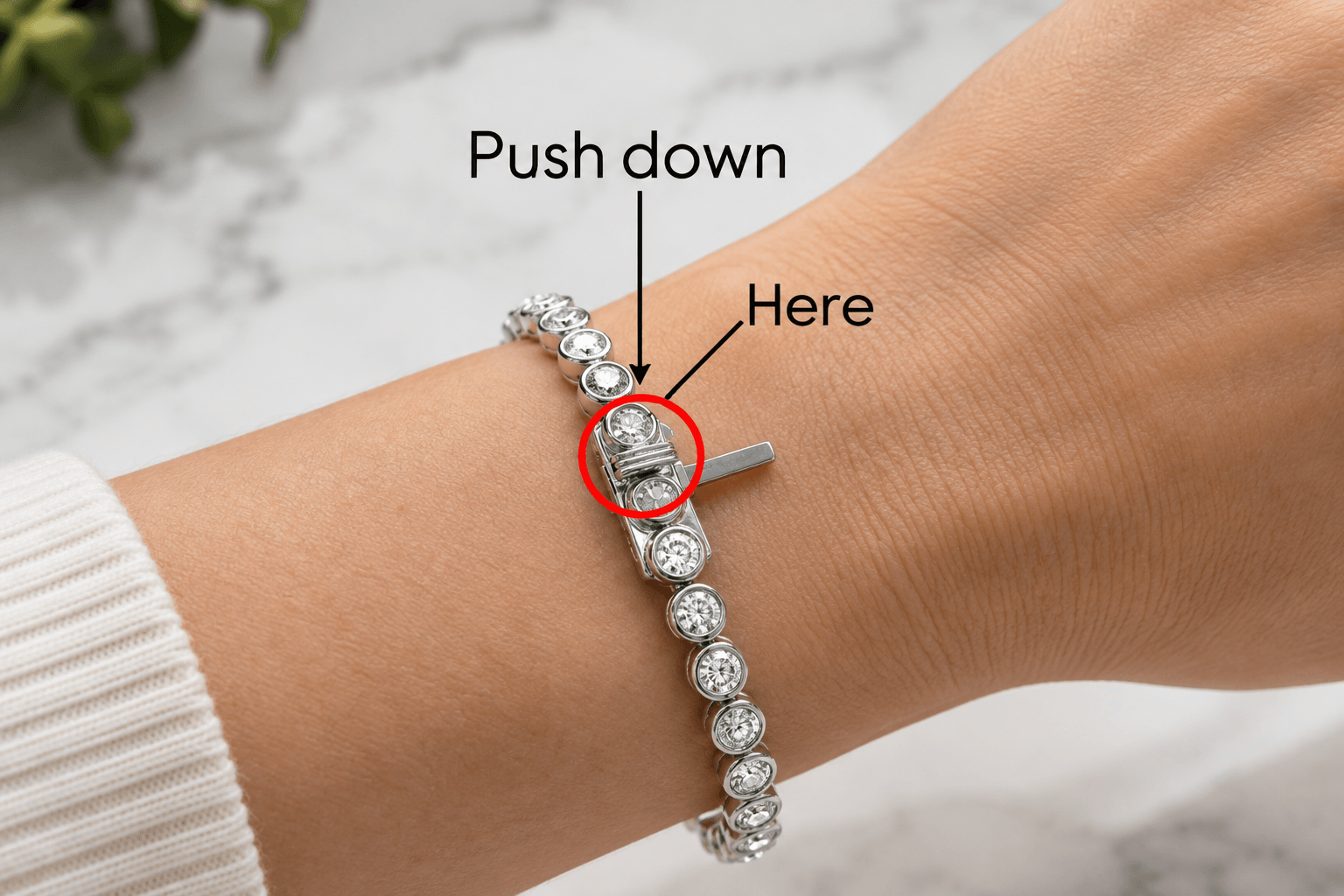
Step 4: Gently Slide the Clasp Apart
While keeping the release depressed, gently separate the two ends.
The tongue should slide out of the receiving section.
You should not need to yank the bracelet.
If it does not move, stop and check that:
The lower safety latch is completely open
You are pressing the correct release point
The two sides are not twisted
You are holding the bracelet close to the clasp
Why Won't My Tennis Bracelet Clasp Open?
The most common reason is that one of the two locking mechanisms has not been fully released.
Before increasing the amount of force you use, check the sequence.
Open the lower safety latch.
Hold the bracelet near the clasp.
Press down firmly on the main release.
Keep the release depressed.
Gently slide the two sections apart.
An underlock clasp is designed to resist ordinary pulling.
That resistance is a feature, not a fault.
Why Does a New Tennis Bracelet Clasp Feel Stiff?
A new tennis bracelet clasp can feel quite firm during its first uses.
That does not automatically indicate a problem.
The components are designed to fit closely together, and the clasp is intended to hold valuable jewelry securely around the wrist.
A very loose new clasp would be much more concerning.
The lower safety latch may also feel firm when new.
As you become familiar with the opening sequence and exact release point, the clasp should become much easier to operate.
The solution is proper technique, not additional force.
How to Close an Underlock Tennis Bracelet Clasp
Closing the bracelet also involves two stages.
The primary underlock should be secured first.
The lower safety latch should then be closed.
Step 1: Align the Two Ends
Bring the two sections of the bracelet together.
Make sure the tongue lines up with the receiving portion.
Do not insert it at an angle.
Step 2: Slide the Tongue Into the Main Clasp
Guide the tongue straight into the receiving side.
Keep the bracelet relatively aligned as you do this.
Step 3: Push Until the Underlock Engages
Continue pushing the two sections together until the main locking mechanism engages.
You may feel or hear a small click.
The two ends should now remain connected.
Step 4: Close the Safety Latch Underneath
Once the primary clasp is secured, close the small safety latch beneath it.
Make sure it moves fully into its locked position.
The safety latch should not be left hanging open while the bracelet is being worn.
Step 5: Check Both Locks
Give the clasp a gentle check.
You are confirming two things:
The main underlock is engaged
The lower safety latch is secured
Do not aggressively pull on the bracelet.
A light check is enough.
Always Close the Safety Latch
It can be tempting to rely only on the main clasp because the bracelet already feels secure.
Do not make that a habit.
The safety latch exists to provide additional protection.
If your tennis bracelet clasp includes it, use it every time you wear the bracelet.
Closing the main clasp without securing the lower latch means you are intentionally leaving one of the bracelet's safety features unused.
Common Tennis Bracelet Clasp Mistakes
Most difficulties with an underlock clasp come from using the wrong technique.
Forgetting the Lower Safety Latch
This is one of the easiest mistakes to make.
If the safety latch underneath is still engaged, the bracelet may refuse to open even when the main release is being pressed.
Release the safety latch first.
Pulling Without Pressing the Main Release
The primary clasp is designed to resist being pulled apart.
Press the release and keep it depressed while separating the ends.
Trying to Open Both Mechanisms at Once
It is easier to treat the clasp as a two step system.
Release the lower safety first.
Then operate the main underlock.
Twisting the Bracelet
The tongue is designed to move relatively straight in and out of the receiving section.
Twisting the ends can place unnecessary sideways pressure on the clasp.
Pulling on the Diamond Links
Hold the jewelry close to the clasp itself.
Do not repeatedly pull from farther down the bracelet.
Prying the Clasp Open
You should not need to wedge a fingernail or another object into the mechanism.
Use the intended release.
Bending the Safety Latch Too Far
The lower latch only needs to move enough to disengage.
Repeatedly bending it far away from the clasp can put unnecessary stress on the metal.
Assuming a Firm Clasp Is Defective
A secure clasp may initially feel tighter than expected.
Before assuming something is wrong, make sure you are using the correct opening sequence.
How the Clasp Looks on Bezel and Claw Set Bracelets
The same basic underlock mechanism can be incorporated into different tennis bracelet styles.
Bezel Set Tennis Bracelets
On a bezel set bracelet, each diamond is surrounded by a smooth metal rim.
The clasp can be incorporated into a slightly larger diamond-set section so that it continues the rounded appearance of the surrounding bezels.
The locking mechanism and safety latch sit largely beneath the decorative surface.
From above, the clasp can blend remarkably well with the rest of the bracelet.
Claw Set Tennis Bracelets
On a claw set bracelet, the diamonds are held by small prongs.
The clasp may look slightly more angular because it needs to integrate with the open structure of the claw settings.
The visible appearance changes, but the basic mechanism can remain the same.
The main lock secures the bracelet.
The lower safety latch provides additional protection.
Why Underlock Clasps Work Particularly Well on Bezel Bracelets
Bezel tennis bracelets provide a good example of how discreet an underlock clasp can be.
Rather than interrupting the bracelet with a visibly separate block of metal, the closure can be integrated into a diamond-set section that resembles the surrounding links.
When closed, the wearer mainly sees diamonds and polished metal.
The functional components remain underneath.
This allows the tennis bracelet clasp to provide security without competing visually with the diamonds.
How Tight Should a Tennis Bracelet Clasp Feel?
A properly functioning clasp should feel secure.
The main underlock should not release from ordinary movement.
The lower safety latch should also remain engaged during wear.
At the same time, neither mechanism should require extreme force when operated correctly.
If you find yourself pulling hard enough that you are concerned about damaging the bracelet, stop.
Check that the safety latch is open and that you are pressing the main release correctly.
What If the Safety Latch Becomes Loose?
The safety latch should remain securely closed during normal wear.
If it begins opening on its own, feels noticeably loose, or no longer sits correctly against the clasp, stop wearing the bracelet until it can be inspected.
The same applies if the main underlock begins releasing unexpectedly.
The two mechanisms are designed to work together.
A safety latch should not be treated as a substitute for a faulty main clasp, and the main clasp should not be relied upon indefinitely if the secondary safety is damaged.
How to Care for an Underlock Clasp
The clasp contains moving components, so it benefits from a little care.
Try to:
Always use the release mechanism
Open the lower safety latch gently
Avoid twisting the clasp
Keep lotions and creams from building up inside the mechanism
Make sure both locks are secured before wearing
Hold the bracelet near the clasp when opening it
Check periodically for unusual looseness
Have the clasp inspected if its behavior changes
Regular jewelry cleaning can also help prevent debris from accumulating around the closure.
Underlock Clasps on Tennis Necklaces
Underlock style closures may also be used on tennis necklaces.
The same design philosophy applies.
A tennis necklace is built around a continuous line of diamonds, so a large visible clasp would interrupt the design.
A compact closure can remain integrated into the jewelry while still providing secure fastening.
Where a lower safety latch is present, the same basic sequence applies.
To open:
Release the safety latch.
Press the main release.
Slide the clasp apart.
To close:
Engage the main clasp.
Close the safety latch.
Check that both are secure.
Underlock vs. Butterfly: Which Is Easier to Use?
This often comes down to familiarity.
A butterfly clasp has an obvious unfolding action, so some people immediately understand how it works.
An underlock clasp can initially feel less intuitive because much of the mechanism is hidden.
However, once you know the sequence, it becomes straightforward:
Safety latch first.
Main release second.
The advantage is that when everything is closed, the clasp remains extremely discreet.
For a tennis bracelet, that can be worth the brief learning curve.
Choosing a Tennis Bracelet Is About More Than the Diamonds
Diamond quality, carat weight, precious metal, and setting style naturally receive most of the attention when choosing a tennis bracelet.
The clasp matters too.
A good tennis bracelet clasp should:
Feel secure
Suit the weight of the bracelet
Be comfortable against the wrist
Be straightforward to operate once understood
Blend naturally with the design
The underlock clasp with a secondary safety latch does exactly that.
It provides two separate points of security while keeping the hardware relatively compact.
Lab Grown Diamond Bezel Set Tennis Bracelet 8.00ctw D/VVS in 10k White Gold
$3,114.00
$5,395.00
Discover the epitome of elegance with our Lab Diamond Bezel Set Tennis Bracelet, a striking statement piece that exudes sophistication. Crafted in luxurious 10k white gold, this bracelet features 8.00ctw of D/VVS quality genuine diamonds, each meticulously bezel set to… read more

The Bottom Line on Tennis Bracelet Clasps
A tennis bracelet clasp may be a small part of the jewelry, but it plays an essential role in protecting the entire piece.
The underlock clasp used on many After Diamonds tennis bracelets combines a compact sliding primary lock with an additional safety latch underneath.
The main underlock connects the bracelet.
The lower latch provides a second layer of security.
To open it:
Release the safety latch underneath.
Hold the bracelet close to the clasp.
Press down on the main release.
Keep the release depressed.
Gently slide the two ends apart.
To close it:
Align the two ends.
Slide the tongue into the receiving section.
Push until the main underlock engages.
Close the safety latch underneath.
Gently check that both mechanisms are secure.
Do not twist the clasp.
Do not pry it apart.
Do not bend the safety latch farther than necessary.
And do not try to overcome a properly engaged lock by pulling harder.
Once you understand the two stage system, an underlock tennis bracelet clasp becomes straightforward to use.
When closed, it provides the security the bracelet needs while allowing the diamonds to remain the focus.
Feel free to have a look through our beautiful and always secure tennis bracelets today!
FAQs
How do you open an underlock tennis bracelet clasp?
First release the safety latch underneath. Then press down on the main release and keep it depressed while gently sliding the two ends apart.
What is the small latch underneath my tennis bracelet clasp?
It is an additional safety mechanism. It should be released before opening the main underlock clasp and secured again after the primary clasp has been closed.
Why won't my tennis bracelet clasp open when I pull it?
The clasp is designed to resist pulling. Make sure the lower safety latch is open, then press the main release while gently separating the two sides.
What is an underlock clasp?
An underlock clasp is a compact closure where one end slides into the receiving section and locks into position. Many designs also include a separate safety latch underneath.
What is the difference between an underlock clasp and a butterfly clasp?
An underlock uses a sliding primary closure, often with an additional safety latch. A butterfly clasp opens through hinged sections that fold inward and outward.
Is an underlock clasp secure?
A properly functioning underlock clasp with its safety latch secured provides two points of protection against accidental opening.
Why is my new tennis bracelet clasp difficult to open?
New clasp components can fit firmly together. Make sure the lower safety is released and that you are pressing directly on the main release rather than trying to pull the bracelet open through force.
How do you close an underlock clasp?
Slide the tongue into the receiving section until the primary lock engages, then close the safety latch underneath.
Can underlock clasps be used on bezel tennis bracelets?
Yes. They can be incorporated into the bezel-set portion of the bracelet so the clasp blends closely with the surrounding diamond settings.
Can underlock clasps be used on claw set bracelets?
Yes. The same basic mechanism can be incorporated into claw set tennis bracelets.
What should I do if the safety latch becomes loose?
Stop wearing the bracelet and have the clasp inspected. Both the primary underlock and the secondary safety latch should function correctly before the bracelet is worn.