Table of Contents
- What Is a Lab Grown Diamond?
- How Lab Grown Diamonds Are Made
- What Is an HPHT Diamond?
- How the HPHT Process Works
- What Is a CVD Diamond?
- How the CVD Process Works
- CVD vs. HPHT: What's the Difference?
- Is CVD Better Than HPHT?
- Can You See the Difference Between CVD and HPHT?
- Can a CVD Diamond Be HPHT Treated?
- Are CVD and HPHT Diamonds Real Diamonds?
- How Long Does It Take to Grow a Lab Grown Diamond?
- What Happens After a Lab Grown Diamond Is Made?
- Are Lab Grown Diamonds Cut Differently?
- Can Lab Grown Diamonds Be D Color and VVS Clarity?
- Why Do Lab Grown Diamonds Cost Less?
- Does CVD or HPHT Matter When Buying Jewelry?
- Do Lab Grown Diamonds Require Mining?
- Common Myths About How Lab Grown Diamonds Are Made
- The Bottom Line on How Lab Grown Diamonds Are Made
- FAQs
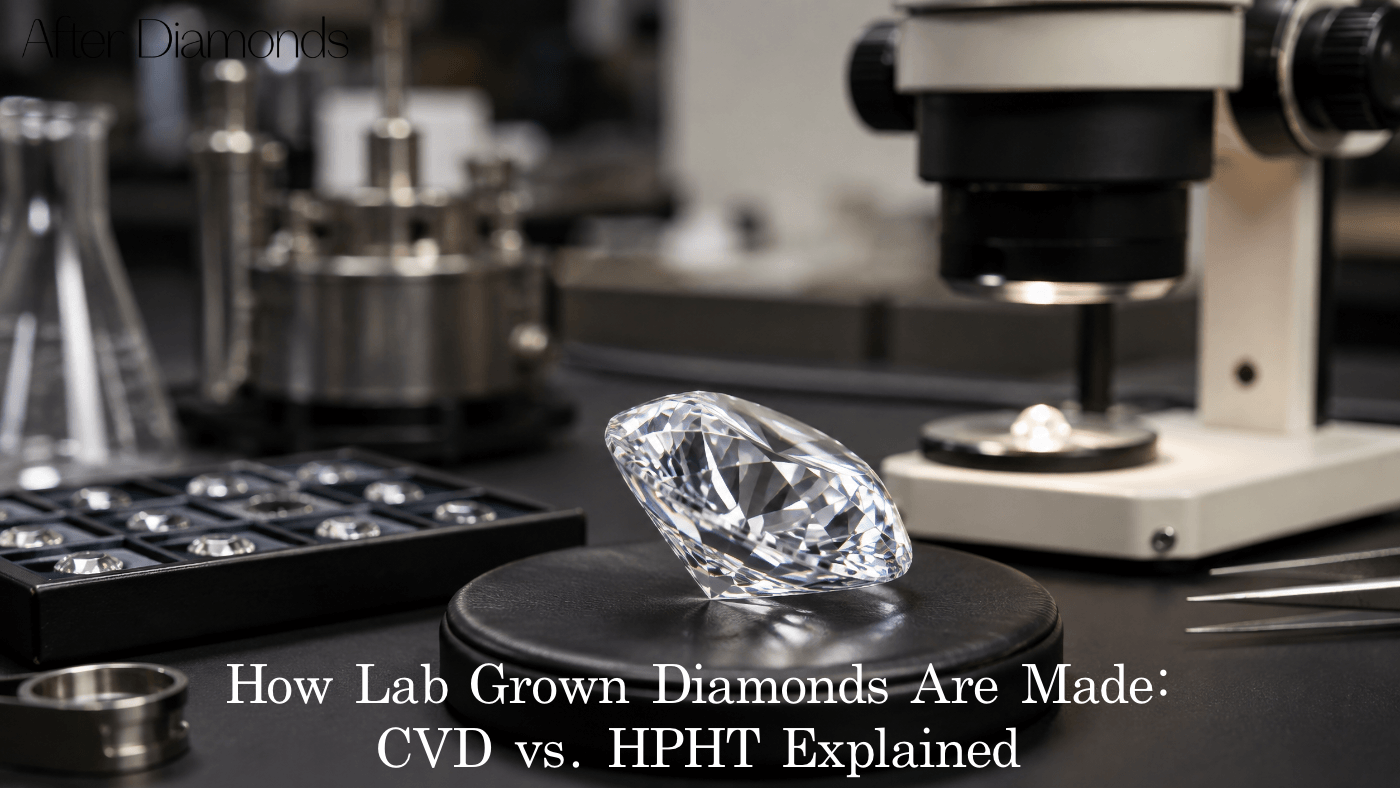
Understanding how lab grown diamonds are made starts with a surprisingly small piece of material: a diamond seed.
Instead of being mined from the Earth, lab grown diamonds are created in controlled environments where carbon atoms are encouraged to form the crystal structure of diamond. There are two main methods used today: Chemical Vapor Deposition, known as CVD, and High Pressure High Temperature, known as HPHT.
The technology may sound futuristic, but the finished material is real diamond.
Lab grown diamonds have essentially the same chemical composition, crystal structure, hardness, and optical properties as natural diamonds. They are not cubic zirconia, moissanite, or glass.
The major difference is origin.
Natural diamonds formed deep within the Earth. Lab grown diamonds are created using advanced technology.
So, let's look at how lab grown diamonds are made and what actually happens inside CVD and HPHT growth systems.
What Is a Lab Grown Diamond?
A lab grown diamond is a diamond created in a controlled production environment rather than recovered through mining.
The process begins with a small piece of diamond called a seed or substrate.
This seed provides an existing diamond crystal structure. Under carefully controlled conditions, additional carbon atoms attach to it and continue that structure.
The material that grows from the seed is diamond.
Once the crystal becomes large enough, it is removed from the growth equipment.
But it still does not look like the polished diamond you would see in a ring or tennis bracelet.
It is rough diamond material that must be planned, cut, faceted, and polished.
How Lab Grown Diamonds Are Made
There are two primary technologies used to grow diamonds:
CVD, or Chemical Vapor Deposition
HPHT, or High Pressure High Temperature
Both methods use a diamond seed and a source of carbon.
However, they create diamond growth in very different ways.
HPHT uses enormous heat and pressure.
CVD uses carbon-rich gas inside a low pressure chamber.
Both methods can produce high quality diamonds suitable for fine jewelry.
What Is an HPHT Diamond?
HPHT stands for High Pressure High Temperature.
It was the first major technology successfully used to manufacture diamonds commercially.
The concept is relatively straightforward.
A diamond seed is placed inside specialized equipment with a carbon source. Enormous pressure and heat create conditions in which carbon can crystallize onto that seed.
The temperatures involved can reach roughly 1,300 to 1,600°C, while pressure can reach several gigapascals.
This is one answer to how lab grown diamonds are made: technology creates an extreme environment in which carbon can build a larger diamond crystal.
How the HPHT Process Works
The HPHT process can be broken into several stages.
1. A Diamond Seed Is Prepared
A small piece of diamond is placed inside a growth cell.
The seed acts as the foundation for the new crystal.
2. A Carbon Source Is Added
Carbon, often in the form of graphite, is placed inside the equipment along with a metallic material that helps facilitate growth.
3. Extreme Heat and Pressure Are Applied
Specialized presses create extremely high pressure and temperature.
Under these conditions, the carbon can dissolve into the metallic material.
4. Carbon Crystallizes Onto the Seed
Carbon moves toward the cooler diamond seed and begins forming additional diamond crystal.
The crystal becomes larger as growth continues.
5. The Rough Diamond Is Removed
Once the desired amount of growth has occurred, the diamond is removed.
At this stage it is still rough.
It must undergo cutting and polishing before becoming a finished gemstone.
What Is a CVD Diamond?
CVD stands for Chemical Vapor Deposition.
CVD provides a very different answer to how lab grown diamonds are made.
Instead of recreating enormous pressure, the process uses carbon-rich gases inside a controlled chamber.
Thin diamond seeds are placed inside the chamber.
A mixture commonly containing hydrogen and methane is introduced.
Energy is then used to create a plasma that breaks down the gas molecules.
Carbon reaches the surface of the diamond seeds and gradually forms additional diamond material.
The crystal grows layer by layer.
How the CVD Process Works
CVD growth can also be understood in a few basic stages.
1. Diamond Seeds Are Prepared
Thin pieces of diamond are placed inside the chamber.
Several seeds may be grown at once.
2. Carbon-Rich Gas Is Introduced
The chamber is filled with gases that provide the carbon needed for diamond growth.
Methane is commonly used as a carbon source.
3. Plasma Is Created
Microwave energy or another energy source activates the gases.
This creates a plasma and breaks molecules apart.
4. Carbon Reaches the Seed
Carbon atoms move toward the diamond substrate.
Because the seed already has a diamond crystal structure, new carbon can continue forming that structure.
5. The Diamond Grows
Additional diamond material builds gradually on the seed.
The process can continue for weeks depending on the desired crystal.
6. The Crystal Is Removed
Once growth is complete, the rough diamond is removed.
It is then ready for the same general planning, cutting, and polishing stages required to turn rough diamond into finished jewelry.
CVD vs. HPHT: What's the Difference?
When learning how lab grown diamonds are made, CVD and HPHT are the two technologies you will encounter most often.
| Feature | CVD | HPHT |
|---|---|---|
| Full name | Chemical Vapor Deposition | High Pressure High Temperature |
| Starting material | Diamond seed | Diamond seed |
| Carbon source | Carbon-rich gas | Solid carbon source |
| Pressure | Low pressure | Extremely high pressure |
| Temperature | Lower than HPHT | Extremely high |
| Growth method | Layered growth on a substrate | Crystal growth around a seed |
| Result | Diamond | Diamond |
| Fine jewelry use | Yes | Yes |
The manufacturing processes are very different.
The finished material is still diamond in both cases.
Is CVD Better Than HPHT?
Not necessarily.
It is easy to find claims suggesting that one method automatically produces better diamonds.
That is too simplistic.
Both CVD and HPHT can produce exceptional gem quality material.
Both can also produce diamonds with characteristics that affect color and clarity.
For a jewelry buyer, the finished diamond matters more than the growth method alone.
You should pay attention to characteristics such as:
Cut
Color
Clarity
Carat weight
Proportions
Polish
Symmetry
A beautifully cut CVD diamond can be exceptional.
A beautifully cut HPHT diamond can be exceptional.
Can You See the Difference Between CVD and HPHT?
Usually not with the unaided eye.
CVD and HPHT diamonds can have different microscopic growth characteristics, but these are generally identified using specialized gemological equipment.
A professional laboratory can study features within the diamond and determine how the crystal formed.
To someone looking at a finished diamond in jewelry, the growth method is generally not visually obvious.
That is why understanding how lab grown diamonds are made is interesting scientifically, but it should not replace evaluating the actual quality of the stone.
Can a CVD Diamond Be HPHT Treated?
Yes.
This is an important point because the two technologies can sometimes be used on the same diamond at different stages.
A diamond may originally be grown using CVD and later undergo HPHT treatment.
This can be done to improve certain color characteristics.
That does not mean the diamond suddenly becomes an HPHT grown diamond.
Its original growth method remains CVD.
HPHT was simply used afterward as a treatment.
Are CVD and HPHT Diamonds Real Diamonds?
Yes.
CVD and HPHT describe how lab grown diamonds are made.
They do not describe diamond imitations.
A lab grown diamond has essentially the same fundamental chemical composition and crystal structure as a natural diamond.
That makes it very different from materials designed merely to resemble diamond.
Cubic zirconia is not diamond.
Moissanite is not diamond.
Glass is not diamond.
CVD and HPHT diamonds are diamonds.
How Long Does It Take to Grow a Lab Grown Diamond?
Natural diamonds formed over immense geological periods.
Laboratory technology can produce diamond crystals much more quickly.
That does not mean the process is instantaneous.
Growth time depends on:
CVD or HPHT method
Desired crystal size
Production conditions
Equipment
Desired quality
Depending on the method and desired result, growth may take days or several weeks.
Producing larger, high quality crystals requires careful control throughout the process.
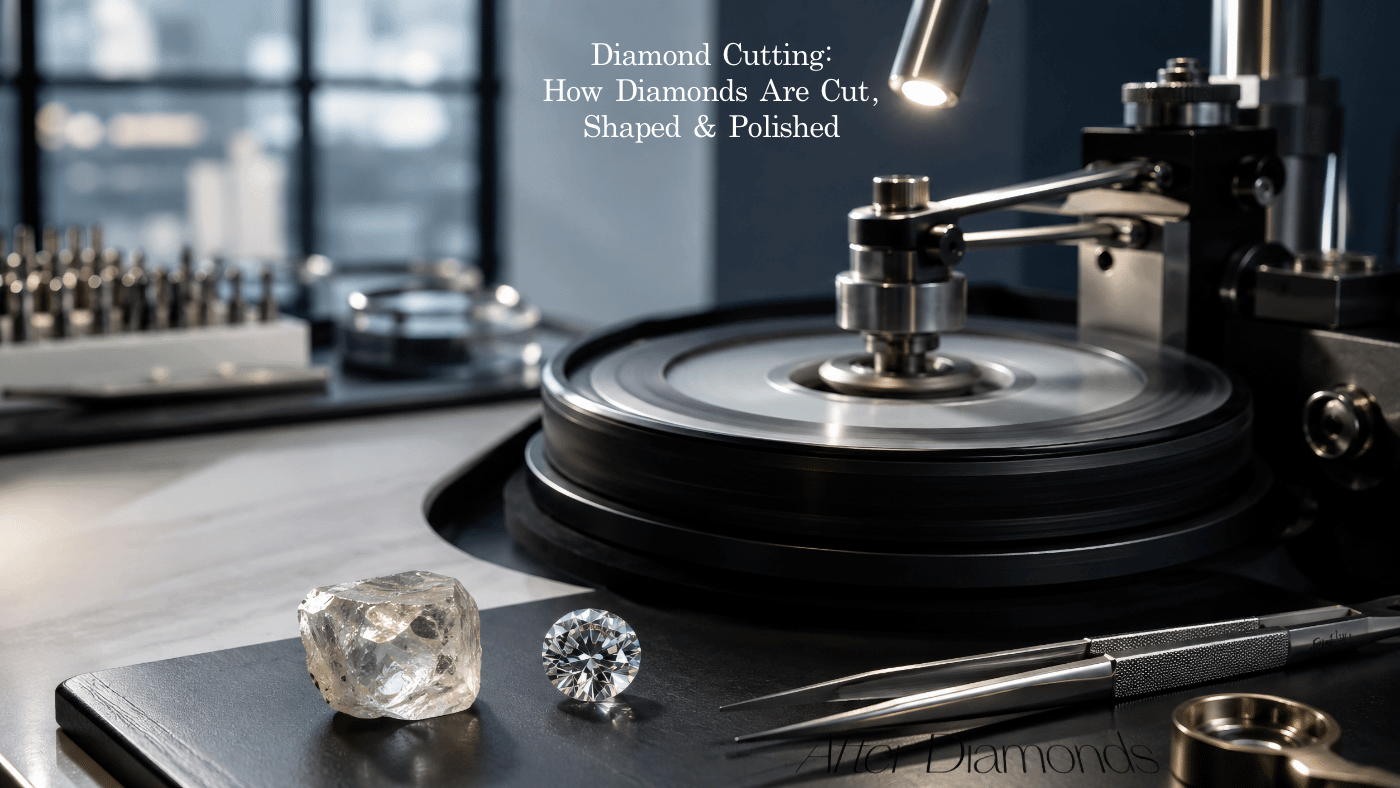
What Happens After a Lab Grown Diamond Is Made?
Understanding how lab grown diamonds are made is only half the story.
Growing the crystal does not produce a finished gemstone.
The rough diamond still needs to go through several stages before it can become jewelry.
These can include:
Scanning the rough diamond
Planning the finished stone
Dividing the rough when necessary
Shaping
Cutting the facets
Polishing
Inspection
Grading when applicable
A rough lab grown diamond can therefore look very different from the sparkling stone eventually set into jewelry.
The cutting process reveals its brilliance.
Are Lab Grown Diamonds Cut Differently?
Not simply because they are lab grown.
Once a suitable crystal has been produced, it can be fashioned into many familiar diamond shapes.
These include:
Round
Oval
Pear
Emerald
Cushion
Radiant
Princess
Marquise
Asscher
Heart
The cutter studies the rough and determines how to achieve the best finished result.
The same basic principles of cut quality, symmetry, proportion, and polish remain important.
Can Lab Grown Diamonds Be D Color and VVS Clarity?
Yes.
Modern growth technology can produce diamonds with very high color and clarity specifications, including D color and VVS clarity.
However, being lab grown does not automatically guarantee those grades.
The environment has to be carefully controlled during crystal growth.
The rough material must then be cut and polished effectively.
This ability to produce high quality diamonds is one reason lab grown jewelry has become particularly attractive for pieces containing many stones.
At After Diamonds, D/VVS lab grown diamonds feature prominently across our jewelry because high specifications can be offered at much more accessible prices than comparable natural diamond jewelry.
Why Do Lab Grown Diamonds Cost Less?
If lab grown and natural diamonds are both diamonds, why can their prices be so different?
The answer largely comes down to supply and production.
Natural diamonds depend on geological deposits.
They must be located, mined, recovered, sorted, and moved through an extensive supply chain.
Once we understand how lab grown diamonds are made, the economic difference becomes clearer.
Diamond-producing technology allows manufacturers to create additional gem quality material without depending on rare natural deposits.
As production technology improves, supply can increase.
For shoppers, this can make it possible to choose:
Larger carat weights
Higher color grades
Higher clarity grades
More substantial jewelry
More diamonds within the same budget
The difference becomes especially noticeable in diamond intensive pieces such as tennis necklaces. A tennis necklace can contain dozens or even hundreds of individually set diamonds, so using lab grown diamonds can dramatically change the total carat weight and quality available within a given budget.
This means buyers can consider substantial diamond necklaces with high color and clarity specifications that would traditionally command an exceptionally high price when made with comparable natural diamonds.
20ctw Lab Grown Diamond Tennis Necklace D/VVS Quality in 14k White Gold
$8,618.00
$15,295.00
Embrace the timeless appeal of white gold with this tennis necklace featuring 20ctw of lab-grown D/VVS quality diamonds. Set in 14k white gold, this 17" necklace provides the perfect fit, while our lifetime workmanship guarantee ensures long-lasting beauty.… read more

Does CVD or HPHT Matter When Buying Jewelry?
For most shoppers, the growth method should not be the first thing considered.
It is useful to understand how lab grown diamonds are made, but CVD or HPHT alone does not tell you whether a finished diamond is beautiful.
When comparing jewelry, consider:
Diamond color
Diamond clarity
Cut quality
Carat weight
Stone matching
Setting quality
Precious metal
Overall craftsmanship
The quality of the finished piece matters more than simply choosing one growth technology over another.
Do Lab Grown Diamonds Require Mining?
The diamond itself does not come from a diamond mine.
That is one of the major differences between natural and lab grown diamonds.
CVD and HPHT allow diamond crystals to originate inside controlled manufacturing environments.
Of course, laboratory production still requires energy, equipment, facilities, materials, and transportation.
No manufacturing process exists without an environmental footprint.
But for shoppers specifically looking to avoid diamond mining, lab grown diamonds provide a direct alternative.
You can learn more about the risks involved with natural mined diamonds by clicking the picture below.

Common Myths About How Lab Grown Diamonds Are Made
Myth: Lab Grown Diamonds Are Fake
False.
CVD and HPHT produce diamond crystal.
Lab grown diamonds should not be confused with simulants such as cubic zirconia.
Myth: CVD Is Always Better Than HPHT
False.
Both methods can produce high quality gem diamonds.
The characteristics of the finished stone matter more.
Myth: Lab Grown Diamonds Come Out of the Machine Ready for Jewelry
False.
The crystal still has to be planned, cut, faceted, and polished.
Myth: Lab Grown Diamonds Are Made From Glass
False.
They are grown from diamond seeds using carbon.
Myth: All Lab Grown Diamonds Are Identical
False.
Just like natural diamonds, lab grown stones can vary in color, clarity, cut, size, and appearance.
The Bottom Line on How Lab Grown Diamonds Are Made
So, how lab grown diamonds are made ultimately comes down to two remarkable technologies.
HPHT uses extraordinary heat and pressure to create an environment where carbon crystallizes onto a diamond seed.
CVD uses carbon-rich gas and plasma inside a low pressure chamber to build diamond material layer by layer.
The processes look very different.
The result in both cases is diamond.
Once grown, that rough crystal must still be planned, cut, polished, and transformed into the brilliant gemstone used in fine jewelry.
Neither CVD nor HPHT is automatically superior.
For shoppers, the quality of the finished diamond matters more than the equipment in which the crystal began.
Lab grown technology has simply created a new origin for one of the world's most recognizable gemstones.
For most of human history, every diamond used in jewelry had to be recovered from the Earth.
Today, we can grow one.
Prefer to see the process in action? This short manufacturing video shows how lab grown diamonds are created using HPHT and CVD technology, then cut and polished into finished gemstones.
FAQs
How are lab grown diamonds made?
Lab grown diamonds are made by growing carbon onto a diamond seed using either CVD, Chemical Vapor Deposition, or HPHT, High Pressure High Temperature technology.
How are CVD lab grown diamonds made?
CVD diamonds are grown in a low pressure chamber containing carbon-rich gas. Energy creates plasma, allowing carbon to build onto a diamond seed layer by layer.
How are HPHT lab grown diamonds made?
HPHT diamonds are produced by exposing a diamond seed and carbon source to extremely high heat and pressure, allowing new diamond crystal to form.
Are lab grown diamonds real diamonds?
Yes. CVD and HPHT diamonds are real diamonds with essentially the same fundamental chemical composition and crystal structure as natural diamonds.
Is CVD better than HPHT?
Neither is universally better. Both methods can produce excellent gem quality diamonds.
Can you tell CVD and HPHT diamonds apart?
Specialized gemological laboratories can identify growth characteristics associated with each method. The difference is generally not obvious to the unaided eye.
Do lab grown diamonds start with a real diamond?
The process begins with a small diamond seed or substrate that provides the crystal structure for additional diamond growth.
How long does it take to make a lab grown diamond?
The time varies according to growth method, size, quality, and production conditions. Growth can take from days to several weeks.
Are lab grown diamonds cut after they are made?
Yes. Rough lab grown diamonds still have to be planned, shaped, faceted, polished, and inspected before they become finished gemstones.
Why are lab grown diamonds cheaper?
Lab grown diamonds can be manufactured using repeatable production technology rather than depending on naturally occurring diamond deposits and mining.