Table of Contents
- What Is Diamond Cutting?
- Diamond Cut vs. Diamond Shape
- Why Diamond Cutting Matters
- How Are Diamonds Cut?
- Step 1: Examining the Rough Diamond
- Step 2: Planning the Diamond
- Step 3: Dividing the Rough
- Step 4: Creating the Shape
- Step 5: Cutting the Facets
- How Many Facets Does a Diamond Have?
- Step 6: Polishing the Diamond
- Step 7: Inspecting the Finished Diamond
- What Makes a Diamond Well Cut?
- The Round Brilliant Cut
- How Is Diamond Cut Graded?
- Does Every Diamond Receive a Cut Grade?
- Popular Fancy Diamond Cuts
- Brilliant Cuts vs. Step Cuts
- A Brief History of Diamond Cutting
- Cut Quality and Carat Weight
- Can Cutting Affect Diamond Clarity?
- Does Diamond Cutting Affect Value?
- Is Cut More Important Than Color or Clarity?
- How Are Lab-Grown Diamonds Cut?
- Cut Quality in Tennis Bracelets and Eternity Rings
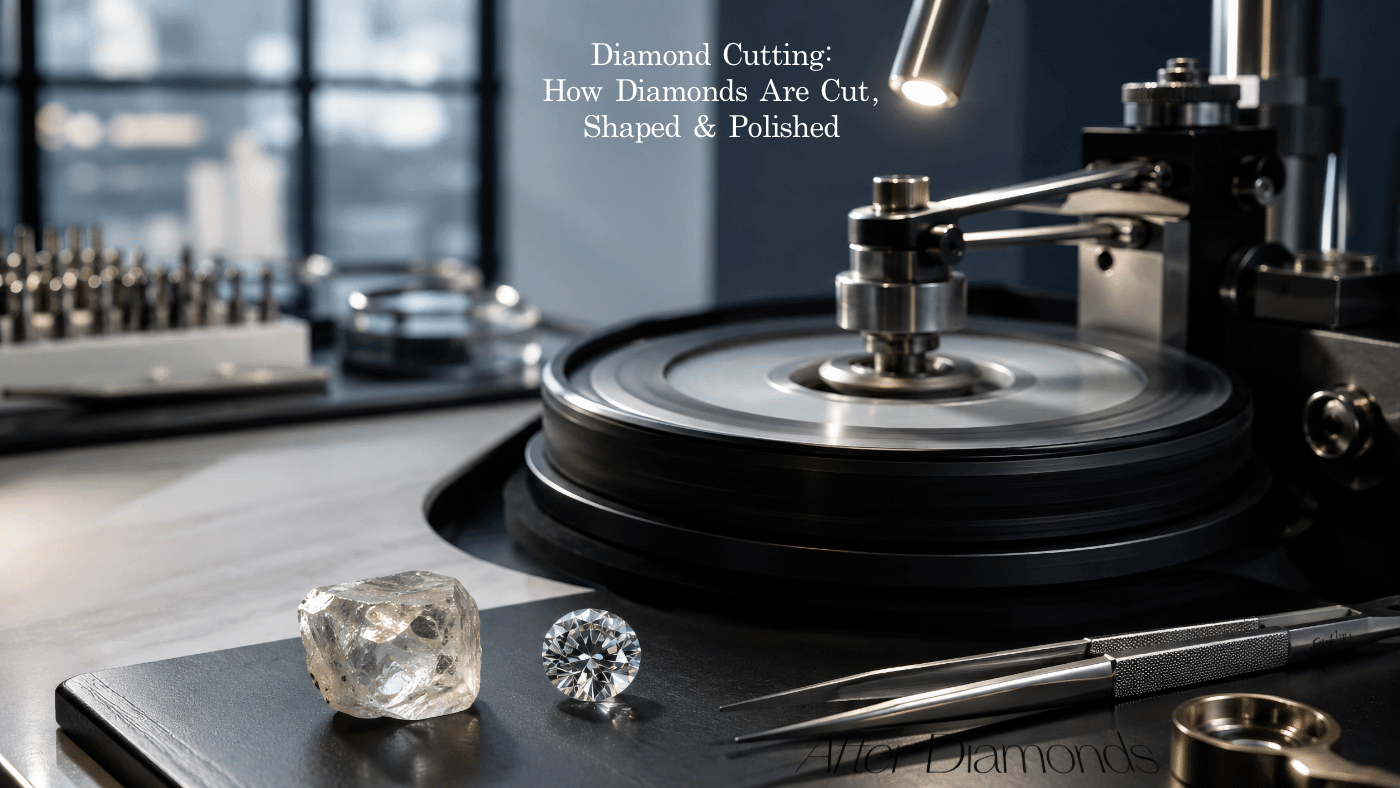
- Modern Diamond Cutting Technology
- Is Diamond Cutting Done by Hand?
- What Should You Look for When Buying a Diamond?
- Common Diamond Cutting Myths
- Why Diamond Cutting Is Both Science and Art
- The Bottom Line on Diamond Cutting
- FAQs
Diamond cutting is the process that transforms a rough crystal into the polished gemstone we recognize in fine jewelry. A rough diamond may look relatively plain, but careful planning, shaping, faceting, and polishing can reveal remarkable brilliance.
This transformation matters because the way a diamond is cut has a major effect on how the finished stone interacts with light.
Color and clarity describe qualities of the diamond itself. Carat tells us its weight. Cut determines much of what the eye actually sees.
A well cut diamond can appear bright, lively, and full of flashes of color.
A poorly cut diamond can look dull even if it has excellent color and clarity.
So how are diamonds cut, and why does the process matter so much?
What Is Diamond Cutting?
Diamond cutting is the process of turning a rough diamond crystal into a finished gemstone.
The process generally includes:
- Examining the rough diamond
- Planning the finished stone
- Dividing the rough
- Creating the basic shape
- Cutting the facets
- Polishing the facets
- Inspecting symmetry and proportions
Each stage affects the final appearance and value of the diamond.
A cutter is constantly balancing different goals.
Should more rough material be preserved to maintain carat weight?
Or should more material be removed to improve proportions and light performance?
The largest possible finished diamond is not always the most beautiful. Sometimes sacrificing a little weight produces a much better result.
Diamond Cut vs. Diamond Shape
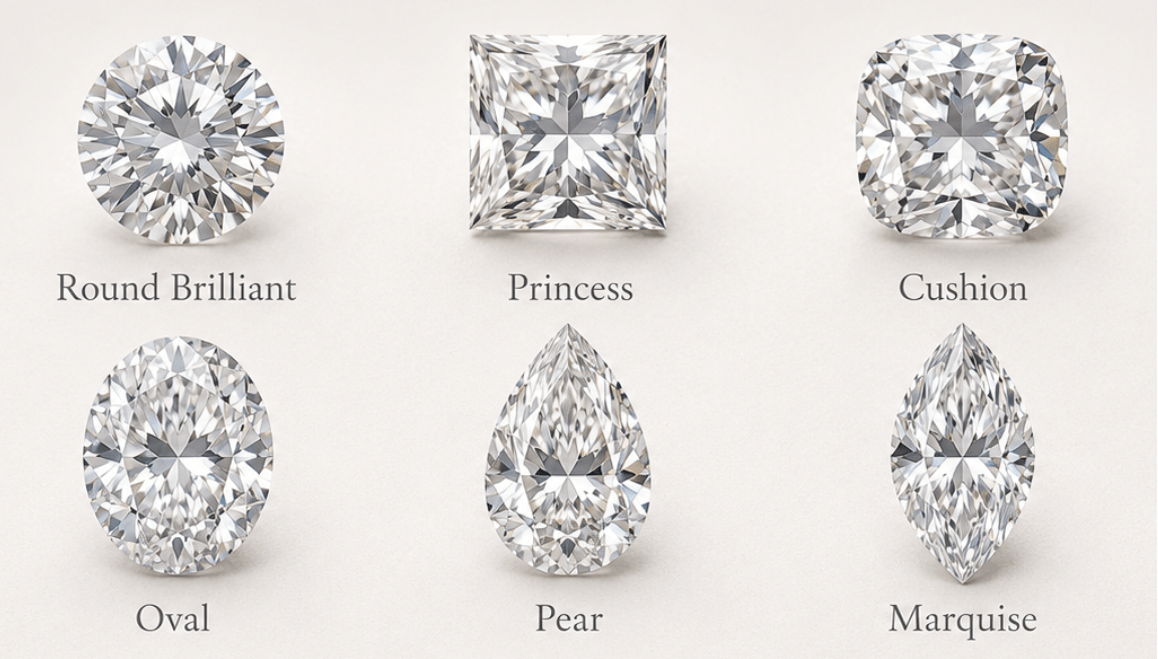
One of the most common misunderstandings in diamond jewelry is the difference between cut and shape.
They are related, but they are not the same thing.
A diamond's shape describes its outline.
Popular shapes include:
- Round
- Oval
- Pear
- Emerald
- Princess
- Cushion
- Radiant
- Marquise
- Asscher
- Heart
Cut refers more broadly to how the stone has been fashioned, including its facets, angles, proportions, symmetry, and polish.
So “oval” describes a shape.
Whether that oval has been beautifully fashioned is a question of cut quality.
Two diamonds with the same shape and carat weight can look completely different depending on how well they were cut.
Why Diamond Cutting Matters
Diamonds are famous for sparkle, but that sparkle depends heavily on how the stone is fashioned.
The facets control how light enters, travels through, and exits the gemstone.
A well cut diamond can produce three major visual effects.
Brightness
Brightness is the white light reflected from a diamond.
It contributes to the overall bright appearance of the stone.
Fire
Fire refers to flashes of spectral color.
As white light passes through a diamond, it can separate into different colors.
Those tiny flashes of red, blue, yellow, and other colors are part of what makes diamonds so visually distinctive.
Scintillation
Scintillation is the pattern of flashes that appears as the diamond, viewer, or light source moves.
This is the lively twinkling effect most people simply call sparkle.
A successful cut balances brightness, fire, and scintillation.
How Are Diamonds Cut?
Modern diamond cutting combines craftsmanship, gemological knowledge, specialized equipment, and advanced technology.
The exact process depends on the rough crystal and the desired finished stone.
Most diamonds go through several important stages.
Step 1: Examining the Rough Diamond
The process begins before anything is physically removed.
The rough diamond first needs to be studied.
Cutters examine:
- Size
- Natural crystal shape
- Internal inclusions
- Surface features
- Possible finished shapes
- Potential carat yield
Historically, cutters relied mainly on experience and optical tools.
Today, advanced scanners and computer software can create three dimensional models of rough diamonds.
These systems help map inclusions and calculate possible cutting plans.
One piece of rough might become one large diamond, two medium stones, or several smaller diamonds.
The cutter must decide which option offers the best balance of beauty and value.
Step 2: Planning the Diamond
Planning is one of the most important stages.
Removing too much material reduces carat weight.
Removing too little can leave poor proportions.
The cutter therefore balances:
- Beauty
- Weight
- Shape
- Clarity
- Market demand
- Value
An inclusion may be positioned so that cutting around it creates a cleaner finished stone.
The natural outline of the rough may favor an oval rather than a round.
Another crystal might produce more value when divided into multiple stones.
Modern software can calculate many possibilities, but experience and judgment still matter.
Step 3: Dividing the Rough
Once the plan is established, the rough diamond may need to be divided.
Historically, cutters sometimes used a technique called cleaving.
Diamond crystals can split along certain structural directions. A skilled cutter could create a groove and carefully separate the stone.
Today, sawing and laser cutting are much more common.
Lasers allow rough diamonds to be divided with remarkable precision.
This stage is critical because material that has been removed cannot be put back.
Step 4: Creating the Shape
After the rough has been divided, the pieces begin to take their basic forms.
For round diamonds, a process traditionally called bruting creates the circular outline.
Historically, one diamond could actually be used against another diamond to shape it.
Modern machinery makes this process significantly more precise.
At this stage, the gemstone may have its general silhouette, but it still lacks the carefully arranged facets responsible for its brilliance.
Step 5: Cutting the Facets
Faceting creates the optical structure of the finished gemstone.
A facet is a flat, polished surface cut onto a diamond.
Each facet has a particular position and angle.
These angles matter because the facets redirect light.
If they are arranged effectively, light entering the stone can reflect internally and return toward the viewer.
If the proportions are poor, more light may escape through the bottom or sides.
This can make the diamond appear darker or less lively.
The goal is not merely to create a symmetrical object. The facets need to work together as an optical system.
How Many Facets Does a Diamond Have?
The number depends on the cut.
A standard round brilliant diamond usually has 57 facets, or 58 if a culet facet is present at the bottom.
Its major parts include:
- Table
- Crown
- Girdle
- Pavilion
- Culet, when present
The table is the large flat facet at the top.
The crown is the upper portion between the table and girdle.
The girdle forms the outer edge.
The pavilion is the lower section.
The culet, if present, is a small facet at the bottom.
All of these areas influence how the diamond appears.
Step 6: Polishing the Diamond
Polishing creates the smooth, reflective surfaces of the finished facets.
Even a correctly positioned facet can perform less effectively if its surface is poorly finished.
Good polishing creates clean surfaces that allow light to interact with the gemstone as intended.
Polish is therefore evaluated separately on many diamond grading reports.
Step 7: Inspecting the Finished Diamond
After cutting and polishing are complete, the finished stone can be inspected.
Gemologists may evaluate:
- Measurements
- Proportions
- Symmetry
- Polish
- Color
- Clarity
- Carat weight
For qualifying round brilliant diamonds, a grading laboratory may also assign an overall cut grade.
The rough crystal is now a finished gemstone ready to be set into jewelry.
What Makes a Diamond Well Cut?
A well cut diamond is not simply one with evenly shaped facets.
Several measurements have to work together.
Important factors include:
Table Size
The table is the large facet at the top of the diamond.
Its size affects how light enters and exits the stone.
Crown Angle
The crown sits above the girdle.
Its angles influence brightness and fire.
Pavilion Angle
The pavilion is the lower section.
Its proportions strongly influence whether light is redirected upward or lost through the bottom.
Depth
Depth measures the distance from the table to the bottom of the stone.
A diamond that is too deep may carry weight where it does not improve its face up appearance.
A stone that is too shallow can also lose light.
Girdle
The girdle forms the outer edge.
An extremely thin girdle may be more vulnerable to damage, while an excessively thick one can retain unnecessary weight.
Symmetry
Symmetry describes how accurately the facets are shaped and aligned.
Polish
Polish describes the quality of the finished facet surfaces.
Good cut quality comes from these characteristics working together rather than from any single measurement.
The Round Brilliant Cut
The round brilliant is the most famous example of modern diamond cutting.
Its design developed over generations as cutters learned more about proportion and light.
A standard round brilliant generally contains 57 or 58 facets.
Its facet arrangement is intended to create a strong balance of:
- Brightness
- Fire
- Scintillation
- Symmetry
Round diamonds are also particularly suitable for standardized cut analysis because their facet structure is highly consistent.
How Is Diamond Cut Graded?
Cut grading evaluates how successfully the rough stone was transformed into a finished diamond.
For qualifying standard round brilliant diamonds in the D to Z color range, the Gemological Institute of America uses five grades:
- Excellent
- Very Good
- Good
- Fair
- Poor
The evaluation considers characteristics including:
- Brightness
- Fire
- Scintillation
- Weight ratio
- Durability
- Polish
- Symmetry
A cut grade is not determined by one measurement.
The relationship among the diamond's proportions matters.
Does Every Diamond Receive a Cut Grade?
No.
GIA currently assigns an overall cut grade to qualifying standard round brilliant diamonds.
Fancy shapes such as oval, pear, emerald, cushion, radiant, marquise, and Asscher diamonds do not receive the same overall GIA cut grade.
However, factors including polish and symmetry can still be evaluated.
This does not make cut quality unimportant for fancy shapes.
Each shape has its own proportions, patterns, and visual characteristics that need to be considered carefully.
Popular Fancy Diamond Cuts
Any shape other than the standard round brilliant is generally considered a fancy shape.
Some of the most popular include:
Oval Cut
Oval diamonds use an elongated outline with brilliant style faceting.
They can provide excellent visual spread and an elegant appearance in rings and pendants.
Pear Cut
Pear diamonds combine a rounded end with a pointed tip.
Symmetry is especially important because the outline should appear balanced.
Emerald Cut
Emerald cuts use long step facets.
Rather than creating the same type of intense sparkle as a round brilliant, they produce broad flashes of light and a distinctive hall of mirrors effect.
Cushion Cut
Cushion diamonds generally have a square or rectangular outline with rounded corners.
Different facet patterns can produce noticeably different appearances.
Radiant Cut
Radiant diamonds combine an angular outline with brilliant style facets.
This allows them to offer strong sparkle while maintaining a square or rectangular shape.
Asscher Cut
Asscher cuts use geometric step faceting and are strongly associated with vintage and Art Deco inspired jewelry.
Different shapes require different cutting decisions.
Brilliant Cuts vs. Step Cuts
Diamond styles can also be grouped according to their facet patterns.
Brilliant Cuts
Brilliant cuts use numerous facets designed to emphasize sparkle.
Examples include:
- Round brilliant
- Oval
- Pear
- Marquise
- Radiant
- Many cushion cuts
Step Cuts
Step cuts use longer, more linear facets arranged in rows.
Examples include:
- Emerald cut
- Asscher cut
Step cuts tend to create broad flashes and geometric patterns rather than the smaller flashes associated with brilliant cuts.
Neither style is inherently better.
They simply produce different visual effects.
A Brief History of Diamond Cutting
Diamond cutting has changed enormously over the centuries.
Early diamonds were valued for their natural crystal forms, hardness, and rarity.
Cutters initially had only limited ability to reshape them.
Over time, new techniques emerged.
Point Cut
Early cutters polished the surfaces of diamonds while largely preserving their natural octahedral forms.
Table Cut
Flattening the upper point of the crystal created a table facet and represented an important step toward more sophisticated designs.
Rose Cut
Rose cut diamonds feature a flat base with triangular facets rising toward a domed top.
They became popular centuries before modern brilliant cutting.
Old Mine Cut
Old mine cuts typically have cushion shaped outlines, higher crowns, and larger culets.
Their irregular character remains popular in antique inspired jewelry.
Old European Cut
The old European cut moved closer to the modern round brilliant, with a circular outline and a recognizable brilliant style facet arrangement.
Modern Round Brilliant
Advances in mathematics, optics, measurement, and machinery eventually produced the modern round brilliant.
Today's cutters can control facet angles and proportions with extraordinary precision.
Cut Quality and Carat Weight
Carat weight creates an important challenge for cutters.
Preserving more rough material can create a heavier finished diamond.
But retaining too much weight can lead to poor proportions.
A diamond may carry unnecessary weight in its depth, for example.
That means two one carat diamonds can have noticeably different face up sizes.
Carat weight alone does not tell you how large or beautiful a stone will appear.
Skilled cutting balances weight retention with visual performance.
Can Cutting Affect Diamond Clarity?
Yes.
Before a rough diamond is fashioned, inclusions inside it can be studied and mapped.
A cutter may sometimes remove or reduce visible inclusions by changing the plan.
Sacrificing a small amount of weight may result in a cleaner finished diamond.
In other cases, an inclusion is left in place because eliminating it would require removing too much valuable material.
Cutters therefore have to balance clarity, carat weight, shape, and value.
Does Diamond Cutting Affect Value?
Absolutely.
A well cut diamond may:
- Look brighter
- Display stronger fire
- Produce better scintillation
- Appear larger for its weight
- Have more precise symmetry
- Show superior craftsmanship
Poor proportions can leave weight in areas that add little visual benefit or allow excessive light to escape.
For round brilliant diamonds, cut grade can have a meaningful effect on price.
More importantly, it can have a major effect on what the buyer actually sees.
Is Cut More Important Than Color or Clarity?
There is no universal ranking because different buyers have different priorities.
However, cut deserves particular attention because it directly influences light performance.
A diamond with slightly lower color or clarity can still appear spectacular if it is beautifully cut.
A diamond with exceptional color and clarity can look underwhelming if its proportions are poor.
This is why many buyers prioritize cut quality when choosing round brilliant diamonds.
How Are Lab-Grown Diamonds Cut?
Lab grown diamonds undergo essentially the same diamond cutting and polishing process as natural diamonds.
Once a lab grown crystal has been produced, it still needs to be:
- Planned
- Divided
- Shaped
- Faceted
- Polished
- Inspected
A lab grown diamond does not emerge from the growth process looking like a finished jewelry stone.
It still requires skilled craftsmanship.
The same principles of proportion, symmetry, polish, and light performance apply.
Lab grown describes the diamond's origin.
It does not describe the quality of its cut.
A beautifully cut lab grown diamond can display exceptional brightness, fire, and scintillation.
Cut Quality in Tennis Bracelets and Eternity Rings
Cut becomes particularly noticeable in jewelry containing many diamonds.
A solitaire ring may feature one dominant stone.
A tennis bracelet or eternity ring can contain dozens of diamonds positioned beside one another.
Consistency therefore matters.
If the stones vary significantly in cut, proportions, color, or appearance, the finished piece may look uneven.
Well matched diamonds create a continuous pattern of sparkle.
This is particularly noticeable in a classic tennis bracelet, where the stones are the main focus of the design.
12ctw Lab Grown Diamond Tennis Bracelet D/VVS Quality Set in 10k White Gold

$3,395.00
$6,110.00
Celebrate exceptional brilliance with this stunning 12.00ctw lab diamond tennis bracelet set in 10k white gold. A continuous row of brilliant round lab-grown diamonds creates a dazzling display of light and sophistication. Designed to make an impression while remaining timelessly… read more
A tennis bracelet is an excellent example of how multiple individually cut stones can work visually as one piece of jewelry.
Modern Diamond Cutting Technology
Today's diamond industry uses technology that earlier generations of cutters could never have imagined.
Modern tools may include:
- Three dimensional scanning
- Computerized rough planning
- Inclusion mapping
- Laser sawing
- Precision measurement
- Automated polishing equipment
- Computer modeling
These systems allow cutters to evaluate multiple possibilities before removing valuable material.
They can also improve consistency and precision.
Technology has not eliminated craftsmanship, however.
Someone still has to decide what each piece of rough should become.
Someone has to balance weight, shape, clarity, proportions, and value.
Modern diamond cutting remains a combination of science and skilled judgment.
Is Diamond Cutting Done by Hand?
Modern production usually combines human skill with machinery.
Lasers can divide rough stones.
Scanners can map crystals.
Software can calculate potential outcomes.
Specialized machines help create and polish facets with great precision.
Experienced cutters and planners still supervise the process and make important decisions.
It is therefore more accurate to think of modern cutting as a partnership between people and technology.
What Should You Look for When Buying a Diamond?
Understanding cut quality gives you a much stronger foundation for comparing diamonds.
When shopping, consider:
- Shape
- Cut grade when applicable
- Polish
- Symmetry
- Carat weight
- Color
- Clarity
- Face up dimensions
- Overall visual appearance
Do not assume that two diamonds with the same carat weight will look identical.
Do not assume that higher clarity automatically produces a more beautiful stone.
And do not confuse a diamond's shape with the quality of its craftsmanship.
A grading report provides useful information, but the appearance of the finished diamond matters too.
Common Diamond Cutting Myths
Myth: Cut Just Means Shape
False.
Shape describes a diamond's outline.
Cut refers to the facets, angles, proportions, symmetry, and polish that affect the stone's appearance.
Myth: The Biggest Diamond Is Always the Best
Not necessarily.
Preserving excessive weight can lead to less attractive proportions.
A slightly lighter but better cut diamond may look considerably more impressive.
Myth: A D Color Diamond Will Always Sparkle More
False.
Color and cut describe different characteristics.
A D color diamond can still have weak light performance if it is poorly proportioned.
Myth: Lab-Grown Diamonds Do Not Need Cutting
False.
Lab grown crystals must still be planned, shaped, faceted, and polished before becoming finished gemstones.
Myth: More Facets Always Mean More Sparkle
Not necessarily.
The position, angles, proportions, symmetry, and polish of the facets matter more than simply increasing their number.
Why Diamond Cutting Is Both Science and Art
Diamond cutting can be studied mathematically.
Angles can be measured.
Light performance can be modeled.
Computers can simulate possible results.
But cutters still make choices.
They decide which shape best suits the rough.
They decide how much weight should be preserved.
They determine how inclusions influence the cutting plan.
They balance measurable performance with beauty and value.
That combination of science, technology, and craftsmanship is what makes the process so fascinating.
The Bottom Line on Diamond Cutting
Diamond cutting is one of the most important stages in creating a beautiful gemstone.
It determines far more than shape.
The process establishes the facets, proportions, symmetry, polish, and much of the way a diamond interacts with light.
A well cut stone can produce intense brightness, colorful fire, and lively scintillation.
Poor workmanship can prevent even a high color and clarity diamond from reaching its visual potential.
Modern technology has made the process more precise than ever.
Scanners can map rough crystals.
Computers can model different plans.
Lasers can divide diamonds with remarkable accuracy.
Human judgment still matters.
A cutter must balance weight, shape, clarity, proportions, value, and beauty.
Whether a diamond formed beneath the Earth or inside a modern growth chamber, the same principle applies:
The crystal provides the material.
The cut reveals its brilliance.
FAQs
What is diamond cutting?
Diamond cutting is the process of transforming a rough diamond into a polished gemstone through planning, dividing, shaping, faceting, and polishing.
Why is diamond cut quality important?
Cut quality strongly influences how a diamond interacts with light. Good proportions can improve brightness, fire, scintillation, visual size, and overall beauty.
Is diamond cut the same as diamond shape?
No. Shape describes the outline, such as round, oval, pear, or emerald. Cut describes how the stone has been fashioned and how effectively its facets and proportions work together.
How many facets are in a round brilliant diamond?
A standard round brilliant usually has 57 facets, or 58 when a culet facet is present.
What are the GIA diamond cut grades?
For qualifying standard round brilliant diamonds in the D to Z color range, GIA uses five grades: Excellent, Very Good, Good, Fair, and Poor.
Does every diamond receive a cut grade?
No. GIA's overall cut grade currently applies to qualifying standard round brilliant diamonds. Fancy shapes are evaluated differently.
How are lab-grown diamonds cut?
Lab grown diamonds undergo the same general process as natural diamonds. Their crystals must be planned, shaped, faceted, polished, and inspected.
Does diamond cutting affect sparkle?
Yes. The way a diamond is fashioned plays a major role in brightness, fire, and scintillation.
What is the most popular diamond cut?
The round brilliant remains one of the most recognizable and popular styles because its facet arrangement is designed to produce strong sparkle.
Can lasers cut diamonds?
Yes. Lasers are widely used in modern diamond production to divide rough crystals with exceptional precision.